


Emma Margetson / Spatial Materiality : Du centripète au centrifuge 1/2
En 2025, la compositrice britannique Emma Margetson entame une résidence en recherche artistique au sein de l’équipe Espaces acoustiques et cognitifs, autour d’un dispositif de diffusion sonore innovant et singulier : IKO. L’IKO se présente sous la forme d’un icosaèdre, c’est-à-dire un solide à vingt faces, chacune étant équipée d’une membrane de haut-parleur. Développé depuis 2006 par une équipe de l’Institut de musique électronique et d’acoustique de l’Université de musique et des arts performatifs de Graz, l’IKO constitue encore une terra incognita pour la création sonore, dans laquelle Emma Margetson se plonge avec délices.
Formée à l’Université de Birmingham et travaillant aujourd’hui à l’Université de Greenwich (Royaume-Uni), Emma Margetson est avant tout une artiste sonore et compositrice acousmatique :
« Je travaille principalement avec des sons préenregistrés, dans des espaces sonores en trois dimensions. Jusqu’ici, j’ai principalement produit des grandes installations sonores spatialisées ainsi que des compositions pour acousmonium, c’est-à-dire un orchestre de haut-parleurs. »
 En 2021, son université fait l’acquisition d’un IKO et cet étrange solide vibratoire la fascine d’emblée. Aussi, quand elle apprend que l’Ircam sollicite des projets de résidence en recherche artistique sur le sujet, elle saute sur l’occasion. « Ce qui m’a d’emblée séduite avec l’IKO, c’est que la technologie est assez récente », dit Emma Margetson.
« Il n’y a donc pas encore d’habitude, aucune approche, aucune manière de faire déjà sédimentées dans les pratiques compositionnelles. Le jeu est largement ouvert : à nous de l’explorer et d’inventer de nouvelles méthodes de travail ! »
D’autre part, l’IKO est un dispositif de diffusion sonore « centrifuge », c’est-à-dire qu’il diffuse d’un centre vers l’extérieur. Tout le contraire des dispositifs habituels, de la stéréo à l’Ambisonic, qui supposent l’existence d’un « sweet spot », c’est-à-dire un lieu d’écoute idéal, et donc une diffusion « centripète », vers ce sweet spot. Un renversement complet de paradigme, à bien des égards. D’abord parce que l’IKO s’apparente à un « instrument » : une source sonore très localisée, capable de projeter des ondes sonores spécifiques dans toutes les directions. Ensuite, parce qu’on ne peut pas contrôler la réverbération de l’espace acoustique dans lequel on se produit, comme on le fait dans une situation d’écoute conventionnelle.
La plupart des grands ensembles de haut-parleurs qui équipent les salles de concert, studios d’enregistrement et autres espaces électroacoustiques, sont en effet conçus pour optimiser le contrôle de l’acoustique, gommant au passage les propriétés architecturales intrinsèques du lieu dans le but d’homogénéiser l’expérience des auditeurs et auditrices, quelle que soit leur localisation dans l’espace.
« Pour moi, une telle exactitude nous oriente vers une neutralité abstraite dans la relation entre l’espace et le son, ainsi que vers une uniformité dans l’écoute », dit Emma Margetson.
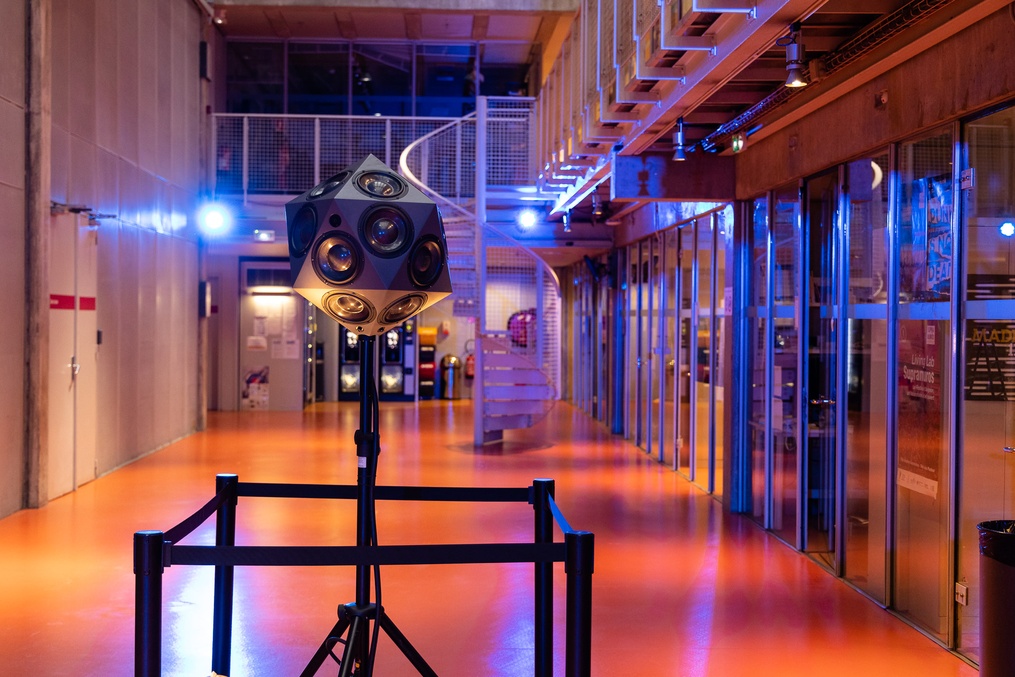 L'IKO à l'ircam © Philippe Barbossa
« L’espace et les mécanismes de reproduction (les haut-parleurs) sont ignorés, absents. Le vide créé par leur absence sépare la personne qui écoute, les technologies et l’espace. Seule l’œuvre est valorisée, comme si elle existait de manière autonome. Avec l’IKO, c’est tout l’inverse, et cela nous force à remettre en question bien des certitudes apprises sur la composition. Les notions d’espace sonore ou de distance aux sources virtuelles (qui composent le paysage sonore diffusé) changent. On bascule dans une « écoute écologique », c’est-à-dire que nos sens sont à l’écoute de la structuration de l’information, de l’environnement. Métaphoriquement, les différents rayonnements sonores de l’IKO activent les propriétés spatiales de l’environnement et donnent vie à la matérialité de l’espace (d’où le titre de ma résidence : « Space Materiality »), en relation avec la matérialité du son et des corps qui écoutent. La projection du son devient partie intégrante de l’écriture. »
C’est d’ailleurs l’un des premiers axes de travail qu’elle se propose d’explorer en collaboration avec les membres de l’équipe Espaces acoustiques et cognitifs, et notamment Thibaut Carpentier et Nadine Schütz : étudier le rayonnement sonore de l’IKO, dans différentes circonstances et avec des matériaux variés.
« Une partie de ce travail passe par du field recording, que je me propose de faire dans Paris, avec un Eigenmike. Ce dispositif d’enregistrement comprend 64 capsules répartis à la surface d’une sphère, et permet de capter des champs sonores en trois dimensions de manière très précise. Ces champs seront ensuite restitués via l’IKO, pour voir comment la directionnalité d’un rayonnement sonore peut être utilisée comme paramètre de composition pour un nouveau type de rendu. Les dynamiques de propagation et de réflexion dans l’espace sont différentes pour chaque fréquence du spectre. Mais ce sont surtout les informations spatiales qui m’intéressent, que l’on peut calculer grâce à des réponses impulsionnelles. On peut par exemple modéliser le rayonnement 3D des instruments de musique ; en appliquant ou en modulant ces schémas de rayonnement au signal de l’IKO, la directionnalité du son de l’IKO devient un véritable paramètre de composition. En extrayant les paramètres spatiaux de la captation d’un champ sonore, j’espère grâce à cette résidence mettre au point de nouvelles approches compositionnelles. »
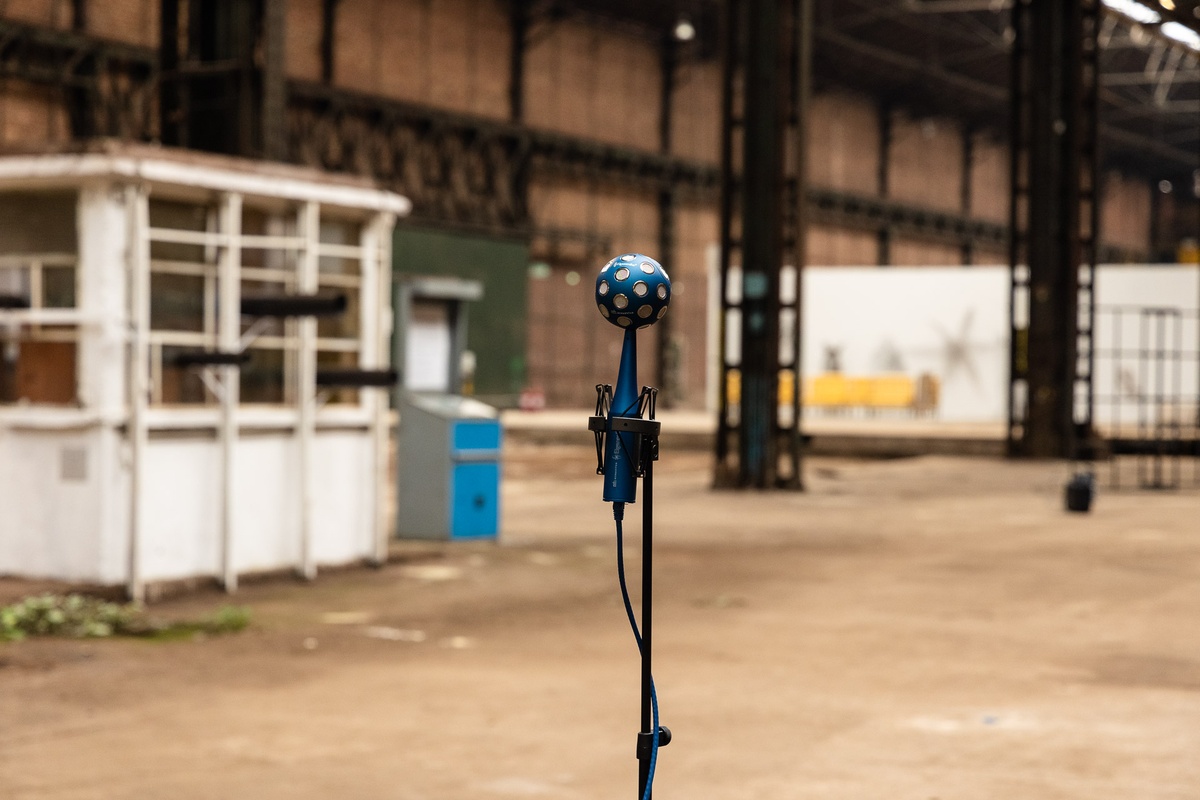
Eigenmike © Philippe Barbossa
L’étude de l’IKO lui-même sera certainement riche d’enseignements. Emma Margetson envisage de manipuler l’espace acoustique dans lequel se situe l’IKO, à l’aide de panneaux réfléchissants par exemple :
« La nature de l’IKO fait que l’acoustique a une influence bien plus grande sur le discours musical qu’avec un dispositif habituel. Chaque lieu lui donne un nouveau visage, permettant de distinguer de nouveaux détails, imperceptibles dans d’autres circonstances d’écoute, de la même manière que chaque mise en lumière d’une statue en change notre perception. Cependant, en tant que compositrice, je souhaite surtout explorer ce nouveau champ des possibles. D’où l’idée de développer des approches compositionnelles et des outils informatiques destinés à analyser et manipuler de manière créative l’environnement d’écoute (virtuel ou réel), et la manière dont l’IKO peut le transformer. On pourrait aussi anticiper la manière dont le public absorbera différentes réflexions, même lorsqu’il se déplacera autour de l’IKO. »
Ambitionnant de composer au moins deux pièces au cours de sa résidence, Emma Margetson espère ainsi aboutir à la réamplification d’environnement acoustiques variés, en ajoutant à sa boîte à outils de composition pour l’IKO des approches propres à l’installation ou à l’art sonores.
Photo d'illustration et dans le texte : Emma Margeston © Sam Walton

Jérémie Szpirglas