

Anthony McCall – Photo
© Darren O’Brien/Guzelian
An encounter with the artist Anthony McCall, whose light projections will be presented at IRCAM as part of the ManiFeste 2026 festival—on their own, in conjunction with, or alongside contemporary musical works. An exploration of his creative process, past and future inspirations, and his perspective on art in all its forms.
With Line Describing a Cone (1973), you redefined our relationship to cinema by shifting attention from the screen to the beam of light itself. Nearly fifty years later, how does this initial line of inquiry continue to resonate in your work?
Anthony McCall
Transforming light into sculptural volume still fascinates me, as I continue to find new ways of developing the original idea. With Line Describing a Cone, I was trying to answer the following question: how can cinema be transformed into something that unfolds in a continuous present, shared with the audience? Later, I realized that the finished film raised further questions—particularly around the notions of “performance” and “sculpture.” It is this dynamic, whereby each new work unexpectedly generates new questions, that continues to drive my practice today. In recent years, it has even led me to develop a series involving mirrors and a body of sound works, while retaining “solid light” as the central aesthetic principle.
Can it be said that your works, unlike narrative cinema, engage the entire body? How do you conceive this physical dimension of your work, and the role of the audience within these installations?
Anthony McCall
Narrative cinema invites the viewer into an imagined “elsewhere”: a moment situated in the past, a distant place.
“My “solid light” films offer a sensual interaction with real sculptural forms, in which the act of looking—the trajectory, duration, and positioning of the gaze—belongs entirely to the viewer.”
Anthony McCall
artist
There is also a question of scale: these planar, diaphanous light forms occupy real space and are shaped in relation to the dimensions of the human body.
Your early “solid light” films used a horizontal projection system, close to conventional cinematic apparatus. Since 2003, you have developed vertical works in which a ceiling-mounted projector creates cones of light descending toward the ground. Why this reversal?
Anthony McCall
This shift reflects both a desire to explore new spatial and perceptual possibilities and a move away from the cinematic framework. There is no doubt that the vertical works are further removed from cinema and perhaps even reference architecture. What interests me in this change of orientation is that the physical scale remains the same: a projection of around nine meters between lens and image, and an image approximately 4.3 meters wide projected onto a wall or the floor. Yet as forms to be explored, the horizontal and vertical versions could not be more different: one is close and enveloping, the other distant, rising above our heads. It is also worth noting that vertical projection only became feasible with the advent of digital projectors. Although I had imagined vertical configurations years earlier, I realized that suspending a 16mm projector—with two reels in motion—ten meters above the ground was simply impossible.
This project with IRCAM establishes a dialogue between your work and that of other artists, such as the composer Morton Feldman, whose works seem to share with yours a minimalist and sculptural aesthetic. To what extent has music influenced your work?
Anthony McCall
As a young artist in the 1970s, I was naturally drawn to new developments across artistic fields—music, dance, theatre, as well as events and happenings. Discussions around music were as vital as they were conceptual. I was particularly interested in the work of John Cage, and I had the opportunity to attend a performance of HPSCHD in London in 1972, which was a major source of inspiration, especially in the way he activated space and placed a mobile audience at the center of the experience. I was also attuned to composers of my generation such as Steve Reich, La Monte Young, Alvin Lucier, and Stockhausen. At the time, I was living in London with Carolee Schneemann, before moving to New York in 1973.
You have also created sound installations, such as Traveling Wave (1972), presented at KANAL–Centre Pompidou in Brussels in 2018. How does this work fit into your broader practice, and what has your experience of working with sound been like?
Anthony McCall
Traveling Wave was one of my earliest works. What interested me was the idea of using white noise to draw three-dimensional sonic volumes moving through space. It was around this time that I also began exploring the concept of “solid light,” where projected light defines volumes suspended in space. Between 1972 and 1974, I was also producing pyrotechnic performances structured around grid systems embedded in the landscape.
I did not return to sound until 2009, with Leaving (with two-minute silence), a horizontal work using two projectors, created in collaboration with David Grubbs. I revisited it again in 2013 with a digital remake of White Noise Installation (1972), which I renamed Traveling Wave (a new version of the original). Sound, light, fire—three immaterial media unfolding in time!
As part of Nuit Blanche 2026 in Paris, you will present Skylight, a “solid light” piece accompanied by a sound work by David Grubbs evoking a storm. Could you tell us about the genesis of this piece and how this collaboration came about?
Anthony McCall
Skylight evokes an imaginary storm emanating from a vertical, solid cone of light. It is part of a body of work I have been developing since 2020, exploring the interactions between sound, silence, and visual form. I presented the finished visual work to David Grubbs with the aim of asking for his help in creating the sensation of a storm. We worked in stages, in constant exchange. David brilliantly succeeded in conveying the sense of a storm approaching and then receding. The final element we added was rain. Lightning, meanwhile, takes a form I particularly appreciate: flashes of light that, for a fraction of a second, illuminate not only the localized volume of the cone but the entire installation space.
This project with IRCAM also includes a concert with Kali Malone, Stephen O’Malley, and Lucy Railton, who will perform in dialogue with your works. What do you expect from this encounter, where music and light coexist simultaneously?
Anthony McCall
As an admirer of their work, I’m very much looking forward to their performance! I like the idea that they perform not “on” my works, but “alongside” them—it’s a very interesting concept. Perhaps the best way to answer is to describe the approach adopted by David Grubbs for my installation Solid Light Works at Pioneer Works in Brooklyn in 2018. By titling the musical performances Four Simultaneous Soloists, he chose to affirm the projections as autonomous works, usually presented in silence. They did not require musical accompaniment, though its presence created a new artistic opportunity.
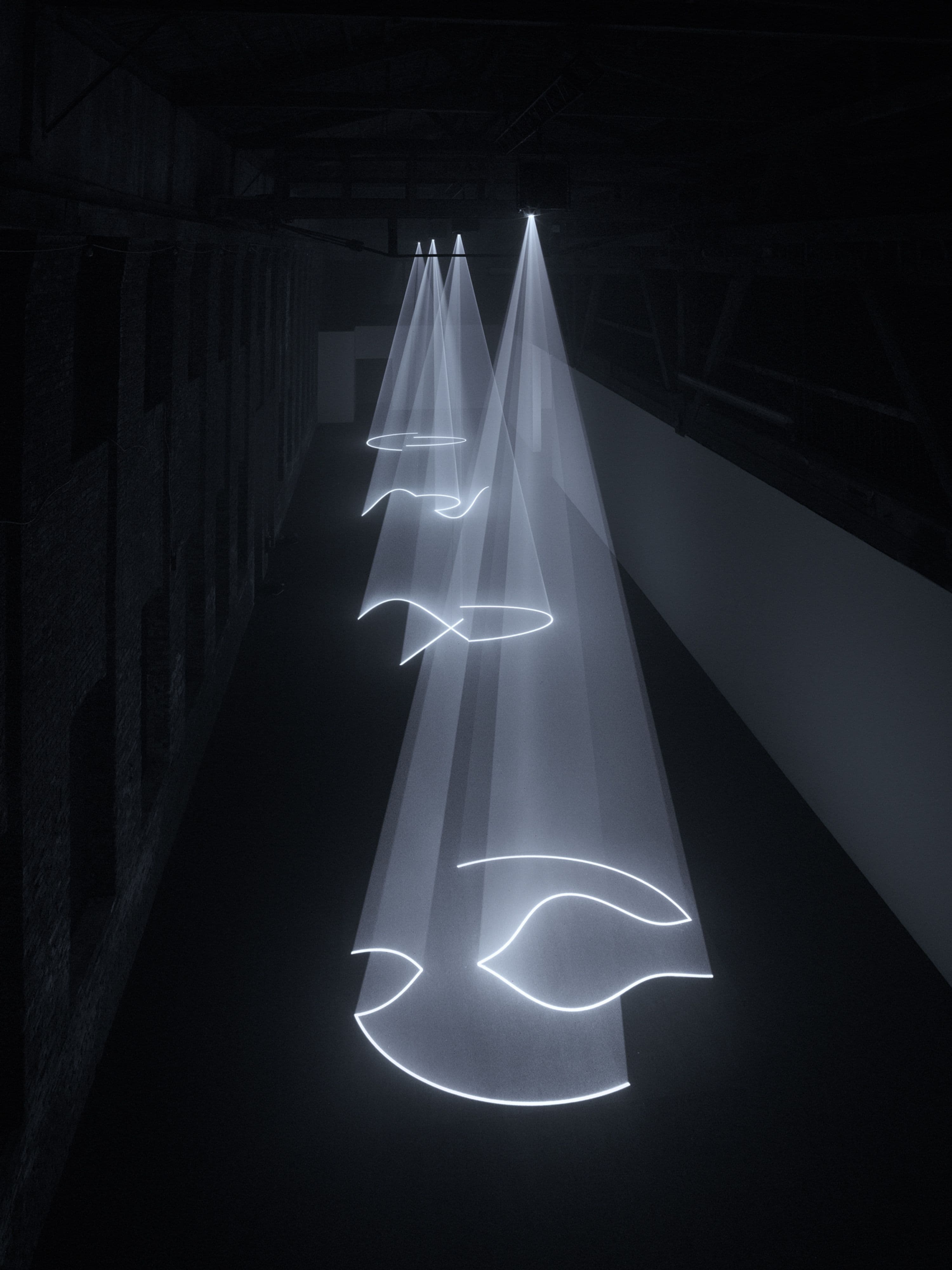 Anthony McCall, installation view, Pioneer Works, Brooklyn, New York, 2018. Photo by Dan Bradica. Image courtesy Pioneer Works - Courtesy of artist, Sean Kelly New York, and Sprüth Magers
A few simple compositional rules guided the improvisation: each performer was to play for half the duration and listen for the other half, and the performance was to unfold organically, as a sequence of solos, duos, trios, and a quartet, without any predetermined structure. The performers remained still, while the audience could move freely through the space. The result: each of the four evenings became a unique concert in its own right—the product of an encounter between two art forms, blending and separating in turn.
By Jonathan Pouthier, Curatorial assistant, film collection, Musée national d’art moderne, Centre Pompidou
Related to this event
Ircam, Espace de projection


