

Anthony McCall, installation view, Pioneer Works, Brooklyn, New York, 2018. Photo by Dan Bradica. Image courtesy Pioneer Works - Courtesy of artist, Sean Kelly New York, and Sprüth Magers
As part of the ManiFeste 2026 festival, the Centre Pompidou and IRCAM invite Anthony McCall to present a major project, reflecting the deeply intermedial nature of his work. The Espace de projection at IRCAM will simultaneously host four monumental works by the artist, offering a rare experience: an encounter between light and music, in which each human presence actively contributes to the emergence of a shared perceptual space.
A major figure in contemporary art, Anthony McCall occupies a singular position at the intersection of experimental cinema, minimalist sculpture, and installation. Born in England and based in New York since the early 1970s, he has developed a radical practice that fundamentally transforms our relationship to cinema. Whereas the traditional cinematic apparatus relies on the illusion of fictive depth, McCall substitutes a real projective space: the event no longer takes place within the projected image, but within the projection itself.
This foundational shift is embodied as early as 1973 in Line Describing a Cone, an emblematic work now held in the collections of the Musée national d’art moderne at the Centre Georges Pompidou. From a simple circular line projected into a smoke-filled space, McCall produces a tangible luminous volume: a cone of light that slowly unfolds in space and time. The beam becomes material, and light becomes sculpture. This “solid light film” in the artist’s own terms, marks a decisive turning point: representation is freed from the frame, and space itself becomes the site of the work. The techniques employed at the time were deliberately rudimentary: gouache drawings on black paper, photographed frame by frame onto 16 mm film. Made visible through smoke, the luminous volume evolves almost imperceptibly, revealing a shifting geometry in constant transformation. Projection is no longer a support, but a performance, continually renewed.
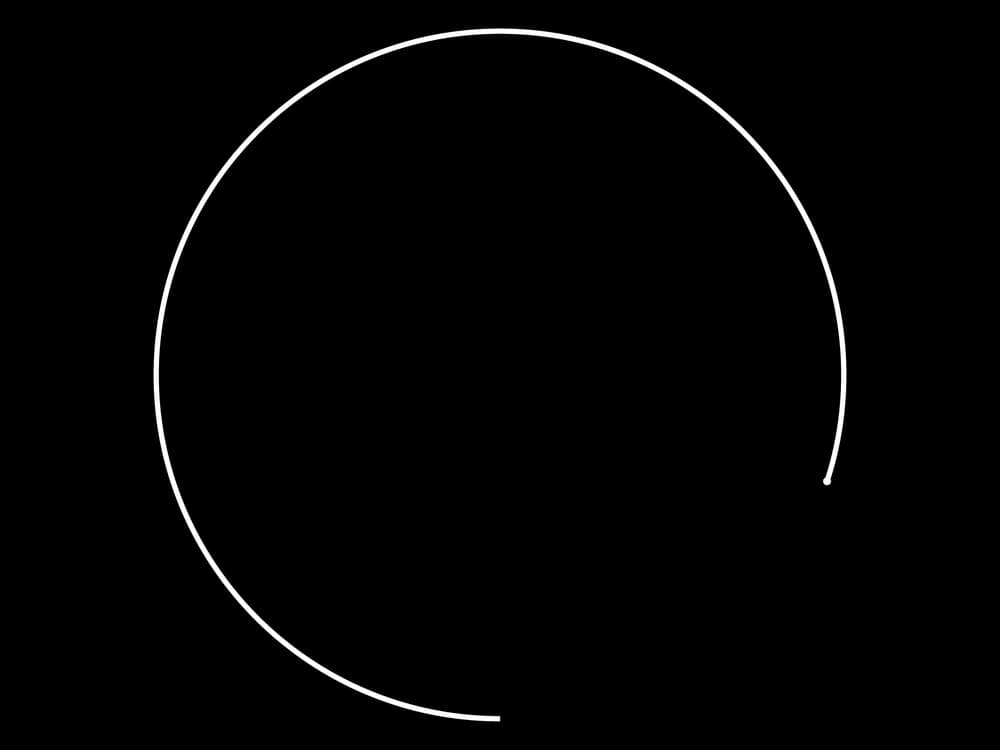 Anthony McCall, "Line Describing a Cone" (1973). Film cinématographique 16 mm noir et blanc, silencieux. Durée : 30' Inv. : AM 1994-F128 12/01/2009, Centre Pompidou, MNAM-CCI/Service de la documentation photographique du MNAM/Dist. GrandPalaisRmn – Courtesy of artist, Sean Kelly New York, and Sprüth Magers
The experience offered to viewers breaks with the conventions of cinema. Here, no stillness is required. The audience is invited to move, to interact with the beams, and to observe the forms from multiple perspectives. Bodies become instruments of perception. Each movement alters the relationship to the work, and each human presence shapes the experience. To describe this as immersion would be reductive. It is more appropriate to emphasize its emancipatory dimension: a reclaiming of the body and the gaze, within an extended temporality that invites attention and anticipation.
The strength of McCall’s work lies in this subtle tension between immateriality and physical sensation. Although light cannot be grasped, it is dense, almost tangible. In interaction with air, dust, or smoke, it reveals its plasticity. Each installation constitutes a fragile balance between technical control and unpredictability, between formal rigor and emergence. Nothing is ever entirely identical: the work lives, reconfigures itself, and is reinvented with each projection.
Anthony McCall’s practice is fully situated within the legacy of the neo-avant-garde of the 1960s and 1970s, ranging from structural film to happenings, and including intermediality and the dematerialization of art. McCall conceives the work as a shared situation, a common present in which the audience does not simply observe, but coexists with the form. Light becomes an autonomous medium, a field of experience in which space, time, and perception converge. At the core of his work lies an inquiry into what it means to see and to inhabit a work today.
This unique installation will be presented to audiences at ManiFeste, featuring four works by the artist: Breath (2004), Breath (III) (2005), You and I (II) (2010), and Skirt (I) (2010). A musical program will resonate with these works, approaching composition as a spatial and temporal experience. This includes Rothko Chapel (1971) by Morton Feldman, a central figure of the New York experimental music scene, performed by the SWR Vokalensemble Stuttgart, as well as the monumental work Does Spring Hide Its Joy by composer Kali Malone, in which her oscillators engage with the guitar of Stephen O’Malley and the cello of Lucy Railton.
By Jonathan Pouthier, Curatorial assistant, film collection, Musée national d’art moderne, Centre Pompidou
Related to this event
Ircam, Espace de projection


