

Le compositeur Morton Feldman, 1976
© Rob Bogaerts
With "Rothko Chapel" and "Coptic Light", the ManiFeste festival pays tribute to a profoundly, and genuinely, singular artistic figure: the American composer Morton Feldman, who would have turned 100 in 2026. The form of the abecedary may be the most fitting way to approach the many facets of a body of work that is as coherent as it is uncompromising, an unceasing endeavor to liberate sound and to expand time.
Amity
Among the great musical friendships—Mozart and Haydn, Brahms and Schumann—one should undoubtedly add that of Morton Feldman and John Cage, fourteen years his senior. They first met one evening in January 1950 in the lobby of Carnegie Hall, after a New York Philharmonic concert featuring Anton Webern’s Symphony, Op. 21, one of their shared idols. This friendship played a catalytic role in “Morty’s” career and resolutely shaped his development: “I don’t know what my music would have become if John hadn’t given me permission to trust my instincts.” Amity, friendship—and notably the creative emulation among the artists of the New York School—was essential to Feldman’s path, despite his otherwise solitary temperament. The titles of many of his works bear witness to this: dedications or greetings addressed to composer friends, painters, poets, and other artists. Among these collaborators, Samuel Beckett would serve as the “librettist” for his only opera, Neither, premiered in 1977.
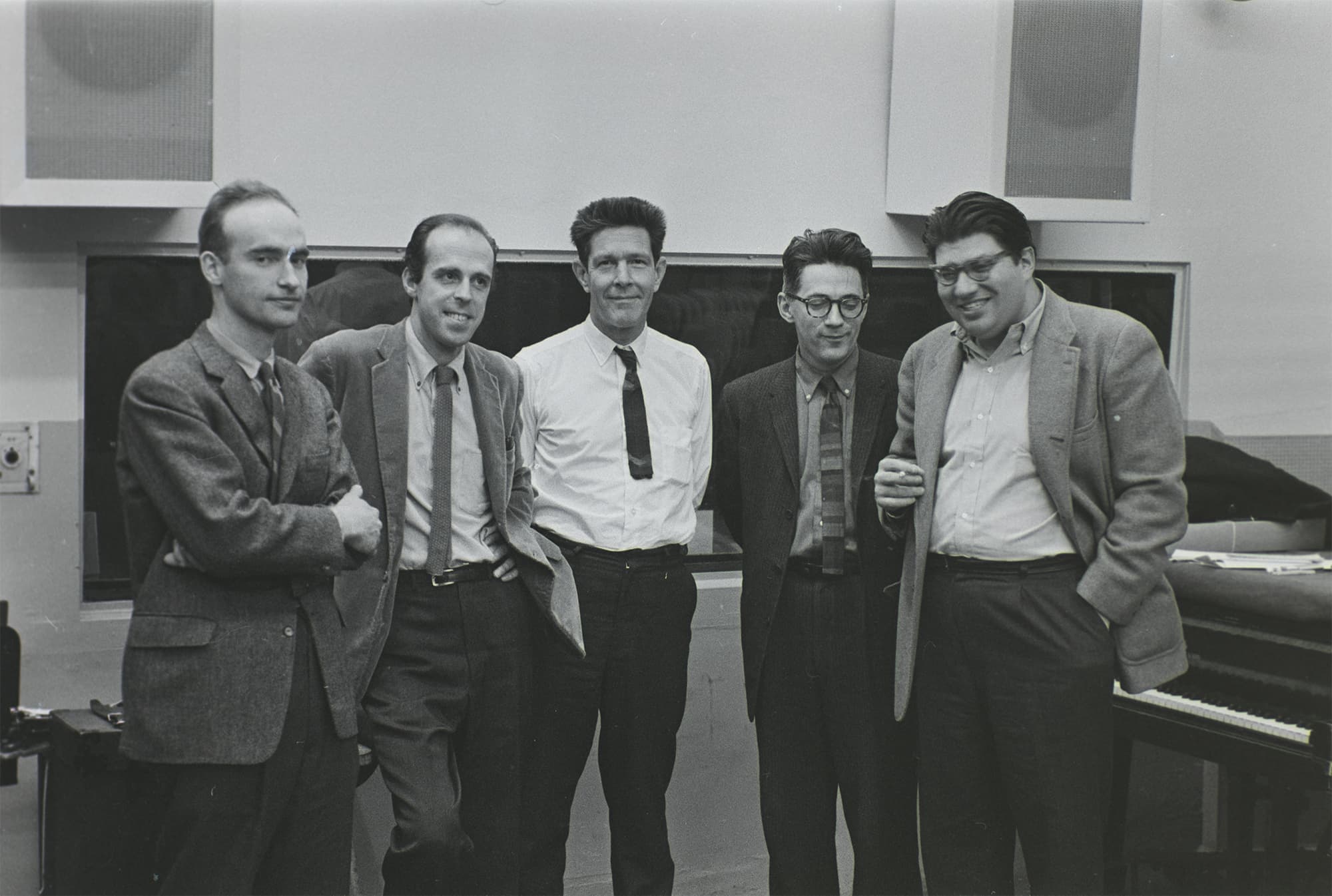 De gauche à droite : Christian Wolff, Earle Brown, John Cage, David Tudor et Morton Feldman, dans un studio d’enregistrement de Capitol Records, à New York, c. 1962 / Photo : Bob Arnold, © Paul Sacher Stiftung, Basel : Earle Brown Collection
Composition
“In that sense, my compositions are not 'compositions' at all. One might call them time canvases in which I more or less prime the canvas with an overall hue of music. I have learned that the more one composes or constructs the more one prevents Time Undisturbed from becoming the controlling metaphor of the music.” In terms of sonic results and harmonic organization, Feldman’s music, which reflects an equal regard for Beethoven and Stravinsky, may appear compatible with serialist doctrine, at least in his works of the 1950s. Yet in its underlying attitude, in the absence of any predefined system or structuring methodology, and in its fundamentally non-dialectical character, this music radically sets its author apart from his European “avant-garde” counterparts of the time, with whom he was nonetheless in contact as a regular guest at the Darmstadt courses.
Duration
Feldman’s aesthetic has often been summarized by the formula “La durée, c’est l’œuvre” (“the piece is its duration”). With sound, and inseparable from it, time is the central concern of Feldman’s creative output. Many of his late works are marked by durations well beyond the norm: 1 hour 15 minutes for For Bunita Marcus (1985); 4 hours for For Philip Guston (1984); 5 hours for the String Quartet (II) (1983)… This is a music of stasis, whose dramaturgy breaks with traditional forms and the codified developments characteristic of “serious” music. A music that dilates time to the point of rendering it almost tangible, while at once stimulating both attention and contemplation.
Éssays
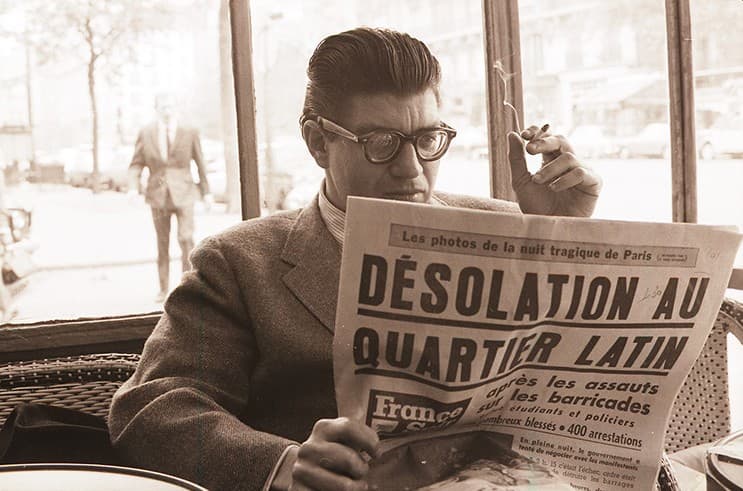 Le compositeur Morton Feldman, Paris, 1968 / Photo : Earle Brown, © Paul Sacher Stiftung, Basel : Earle Brown Collection
Although for him music resists all discourse, Feldman nonetheless left behind a substantial body of writings. Neither theoretical nor rhetorical, his texts, lectures, masterclasses, conversations, and interviews help us to listen more attentively to his works and to grasp the man himself—his humor, his poetry, his quirks, his digressions. In French, these writings are collected in two volumes, from which all the quotations in this article are drawn. The first, Au-delà du style, was published in 2021 by the Éditions de la Philharmonie de Paris. The second, Écrits & paroles, reissued in 2008 by Les Presses du Réel and expanded with a “Monograph” by Jean-Yves Bosseur, includes a preface by Danielle Cohen-Levinas that concludes with these words: “This solitary and paradigmatic figure will have, perhaps even unknowingly, spread around him not a method of composition, nor a theoretical stance, still less a set of aesthetic rules, but what one might call a personal ethic: the conviction that in the arts in general, and in music in particular, each project, each initiative must be pursued in depth—provided one upholds a rigor free of any ideological compromise.” E for Exigence.
Formation
It was Vera Maurina-Press, a former student of Ferruccio Busoni and a friend of Alexander Scriabin, who gave Morton Feldman his first piano lessons at the age of twelve, apparently emphasizing musicality over technique. Feldman would pay tribute to her in 1970 with the piece Madame Press Died Last Week at Ninety. At fifteen, he studied counterpoint with Wallingford Riegger, a pioneer of American twelve-tone composition, and from the age of eighteen he took informal composition lessons with the German Stefan Wolpe, himself a former student of Busoni and Franz Schreker. So, Morton Feldman’s musical education took place largely outside formal academies, “empirical,” to borrow a term he liked to use for a distinctly American musical tradition embodied by Charles Ives, Edgard Varèse, and John Cage, which he contrasted with “formalism.” Feldman occupies a prominent place in Michael Nyman’s book Experimental Music.
Graphical (score)
In 1950, with Projection 1, Morton Feldman invented the graphic score—a pictorial alternative to traditional notation, which would later inspire rich developments. He saw it as a way to remain faithful to “the immediate expression of sound, independently of any compositional rhetoric.” The score for Projection 1 is a grid indicating tempo, timbre, and duration, while pitch and dynamics are left to the performer’s discretion—Feldman specifying only the register: high, middle, or low.
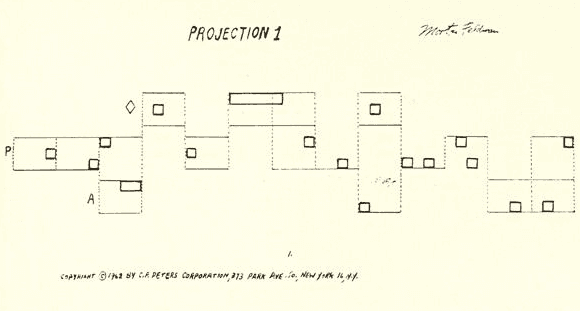 Partition graphique de "Projection 1" de Morton Feldman
He would later experiment with other forms and methods of notation, before gradually returning to the (more or less) traditional score by the late 1950s.
Happenstance
With graphic notation, and under the influence of Cage and the other artists he associated with in New York, Feldman introduced an element of indeterminacy into his music. Yet, unlike Cage, he never truly relied on chance. Performers were certainly free to choose the pitch they would play (within a given register), but each entry was still precisely timed, and every sound carefully organized in space. Perhaps because the margin of improvisation he allowed performers was too wide, Feldman gradually returned to conventional notation. Whereas Cage sought to let sounds roam freely, surprising him in the process, Feldman envisioned a specific soundscape and aimed for a certain perfection in his writing.
Judiaism
Born into a Jewish family of Ukrainian origin, it was in Berlin—where he spent a year at the invitation of the DAAD in 1971–72—that Feldman said he rediscovered his Jewish identity. It was also during this period that he composed Rothko Chapel, a work in which, he wrote, “certain intervals sound like in the synagogue.” In his analysis of the piece, musicologist Laurent Feneyrou explores the analogies between Feldman’s music and the Hebrew phrase, concluding: “With Adorno, with Steiner, Feldman questions the status of the work of art after Auschwitz: ‘I want to be the first great Jewish composer,’ he said.”

The Rothko Chapel (1971)
by Morton Feldman, recorded in 2017
0:00 / 3:00
Languor
Feldman’s pieces take their time. Or rather: their very purpose is to give sounds the space to unfold and interpenetrate. Highly atmospheric (with varying degrees of turbulence), they always unfold at a slow tempo—yet this does not prevent continual changes in meter. Added to this slowness is a pervasive softness: attacks and dynamics as delicate and cautious as possible, with a constant pianississimo nuance. Durations, meanwhile, is a series of five early-1960s scores that explores another technique dear to Feldman: having the same material played by separate groups of instruments, each free to follow its own tempo and to choose the length of its contribution. The resulting staggered effect functions like reverberation, producing a shimmering sonic reflection.

Durations III (1961)
by Morton Feldman, recorded in 2010
0:00 / 2:23
Motif (in the carpet)
Rather than approaching Feldman through the suitcase word Minimalism (“I don’t feel that my music is sparse or minimal”), it is preferable to consider the idea of Motif (Pattern), which appears in the titles of two works (Why Patterns?, 1971; Patterns in a Chromatic Field, 1981) and reflects the pictorial dimension of his music. Beyond painting, Feldman had a deep fascination with Middle Eastern carpets, especially those from Anatolia. Their “truncated symmetry,” irregular rhythm, and imperfect repetition of motifs and colors served as a profound source of inspiration, and the way his pieces interweave registers and timbres often recalls the art of weaving itself. The discovery of the Louvre’s collection of Coptic textiles provided the literal warp and weft for Coptic Light (1986), commissioned by the New York Philharmonic. Impressed by the ability of these fragments of cloth to convey the soul of a civilization, Feldman wondered what, in 2,000 years, might communicate the atmosphere of Western music since Monteverdi. The result is a piece for piano and orchestra in which the orchestra is treated like a “pedal,” blurring the piano’s resonance to produce a kind of sonic chiaroscuro.

Why Patterns? (1978)
by Morton Feldman, recorded in 2000
0:00 / 3:00
New York
Feldman was one of the few members of the New York School art group—an informal, transdisciplinary circle whose musical figures, alongside Cage and Feldman, included Christian Wolff, Earle Brown, and David Tudor—to have been a native of the city, to which his massive silhouette seems eternally bound. Was he born in Queens, Manhattan, or Brooklyn? The sources disagree.
Questions
For Feldman, to compose is to ask questions rather than to provide answers, and to invite others to do the same: “To me, the artist has only one duty, only one duty and nothing other than that, and that one duty is to strip away illusions about things. Our illusions about history. The illusion of progress, the illusion of the public, the illusion of success, the illusion of what is exciting and what is not. Of (…) what is intellectual and what is not intellectual.”
Rothko (Mark)
Intimately connected with the painters of Abstract Expressionism, and passionate about painting, which he briefly practiced himself, Morton Feldman often described his own work in pictorial terms. Abstract music? It certainly offers many analogies with the vibration of different chromatic fields, with the organization of colors, motifs, and figures across a surface, like a temporal canvas. The very first painter to whom he dedicated a work (a film score in 1951) was Jackson Pollock. He was friends with Robert Rauschenberg and Cy Twombly, but Feldman held a particular admiration for Piet Mondrian, Philip Guston, and Mark Rothko, for exploring paths overlooked by modernity. Rothko, in particular, inspired one of his most remarkable scores: Rothko Chapel. Begun in 1971 and premiered the following year, this work for soprano, viola, percussion, and choir was composed for the building of the same name, commissioned in Houston by the patrons John and Dominique de Menil. They had asked Mark Rothko for fourteen monumental paintings to adorn the interior of a space designed for meditation. The painter never saw the finished version: he took his own life in 1970, a year before the chapel’s inauguration. To the homogeneous continuity of his friend’s paintings, “a motionless procession resembling the friezes of Greek temples”, Feldman opposed “a series of highly contrasting, successive sections.” The unreal clarity of the sound textures, the purity of the melody with its Hebrew inflections traced by the viola over a halo of vibraphone at the end of the piece, constitutes the finest tribute that this painting could ever have hoped to receive.
![Mark Rothko, Rothko Chapel (1964 - 1967) © 1998 Kate Rothko Prizel & Christopher Rothko – Adagp, Paris, [2026] – Photo](/_next/image?url=%2Fapi%2Fmedia%2Ffile%2Frothko-chapel.jpg&w=3840&q=75) Mark Rothko, Rothko Chapel (1964 - 1967) © 1998 Kate Rothko Prizel & Christopher Rothko – Adagp, Paris, [2026] – Photo © Hester + Hardaway Photographers, Houston, Texas, USA
Mark Rothko, Rothko Chapel (1964 - 1967) © 1998 Kate Rothko Prizel & Christopher Rothko – Adagp, Paris, [2026] – Photo © Hester + Hardaway Photographers, Houston, Texas, USASound / Silence
Feldman’s music is a quest for sublimation, an exploration of what Makis Solomos, following Varèse, called the “inner life of sound.” He projects timbres through time as one might arrange shades on a canvas. Sound is Feldman’s principal concern… as is its counterpart: silence, from which his works often seem to emerge. Many of his scores, in fact, conclude with a silent measure.
Timbre
Piano, Violin, Viola, Cello (1987), Bass Clarinet and Percussion (1981), Flute and Orchestra (1978), Three Clarinets, Cello and Piano (1971)… The titles of many of Feldman’s works simply list the instruments used, much as one might enumerate the colors of a painting, or, like a gallery label, specify the technique employed.
Varèse (Edgard)
Beyond John Cage, another major encounter in Feldman’s career, facilitated by Stefan Wolpe, was with Edgard Varèse, whose work with sound he deeply admired. In 1973, when Feldman was appointed professor at the University at Buffalo, New York, he was given the Edgard Varèse Chair, which finally allowed him to leave the job he had held in his father’s textile workshop. He held the position until his death in 1987.
Zen
Feldman frequently referred in his talks to Zen philosophy. And his music, by its ability to sharpen listening, often evokes East Asian philosophies. Jean-Yves Bosseur nonetheless emphasizes that Feldman “rejects any form of influence from what he considers merely another system of thought, no better or worse than any other,” adding, with his caustic humor: “My overall debt to Eastern culture is Chinese food.”
By David Sanson
Morton Feldman
Related to this event
Jun 4, 2026
Ircam, Espace de projection

Andrea%2520Fele%25CC%2581gi%2520%2520Editio%2520Musica%2520Budapest-600x450.jpg%3F2026-05-28T14%3A55%3A05.860Z&w=3840&q=90)
