

La compositrice Justė Janulytė
© DR
Justė Janulytė’s new piece, "Encens" (Incense), was created on the request of Italian cello player Francesco Dillon, who wanted to create a solo work that resonated with the masterpiece "Advaya", for cello and electronics, composed by Jonathan Harvey (1939-2012) at IRCAM in 1994.
Aesthetical Issues: Incandescent Incense
A “monochromatic music composer”: this concise description is how Lithuanian composer Justė Janulytė introduces herself – a description that can, for instance, be found on her website. While it tells a lot about her personality, it remains rather enigmatic – in music, the concept of colours encapsulates several issues. In 2023 however, the composer created at IRCAM a piece whose title directly contradicts this self-description: Iridescence, for choir and electronics.

Iridescence de Justė Janulytė
recorded in 2023
0:00 / 2:45
This piece, which will premiere in June 2026 as part of ManiFeste festival, shares similarities with the one she is currently working on in IRCAM’s studios: Encens, in memory of composer Jonathan Harvey. A new work that seems to perfectly match her definition of “monochromatic music”!
Justė Janulytė, who had the chance of knowing the gentleman-composer before his death, is fascinated by his work; which is why, to get started on her new piece, she feels the need to examine Harvey’s musical universe. This is how she remembered that, from the 1980s onwards, Harvey turned to Buddhism – a pull that led him to introduce a genuine mystical dimension in his music, which is reflected in Advaya. Raised as a Catholic, Janulytė tried to search for similarities between the two religions and their rituals that go beyond the simple and evident spiritual aspiration. She found what she was looking for in a custom that, according to archaeologists, features among the most ancient rituals of humankind: the burning of incense – a sentence that is redundant in itself, as the etymology of the word “incense”, “incensum”, means literally “that which is burnt” , its Latin root “incendere” being also at the origin of the word “incendie” (“fire”).
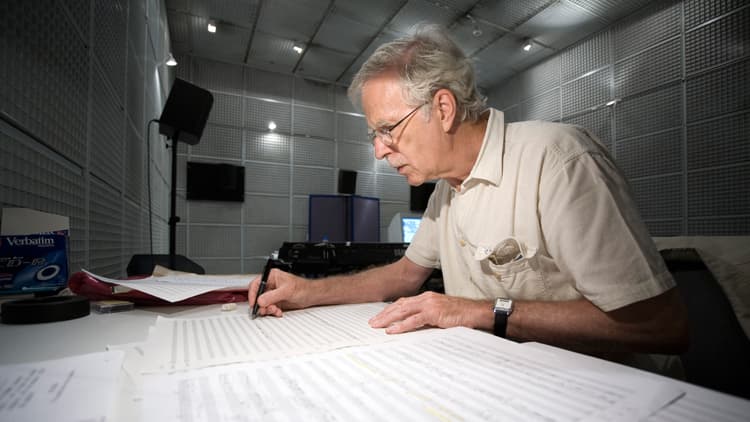 Le compositeur Jonathan Harvey © Florian-Kleinefenn
That is however not the symbolism surrounding the ritual of incense or even its variety of smells from all around the world that inspires her, “Burning incense is not solely a perfect poetical and intercultural symbol, it’s also a visual and kinetic phenomenon, that I thought would be very interesting to translate musically. When you’re burning incense, a thick smoke rises from this unique source, shaping many volutes in its trail that intertwine and separate as they sway upwards.” To subtly enhance her homage to Harvey even further, Justė Janulytė adds a verse from the Dhammapada to her score known as one of the most ancient Buddhist scriptures, “The scents of flowers cannot blow against the wind. Neither can the perfumes of jasmine, sandalwood, or clove.”
Technological Issues: Sound Prism and Mechanical Bow
But rather than imagining volutes of sound swaying up to the sky, Justė Janulytė composes a long, spiralling down progress of the partials, from the highest register to the lowest. In the same way incense burns by producing dense smoke ribbons that fly upwards to join the clump of fragrant volutes, Justė Janulytė develops, throughout the piece, a vast micropolyphonic canon made up of glissandos of partials that end up meeting in unison in the low register – with the cello player accompanying their slow descent. In this piece, computer music plays a role similar to a light prism when it decomposes white light: each colourful beam is diffracted depending on its wavelength, as the prism unfolds the spectrum like a fan. Similarly, the machine unfolds the vertical stacking of partials making up the sound of each starting note – but instead of unfolding it in space like the prism, it does it in time.
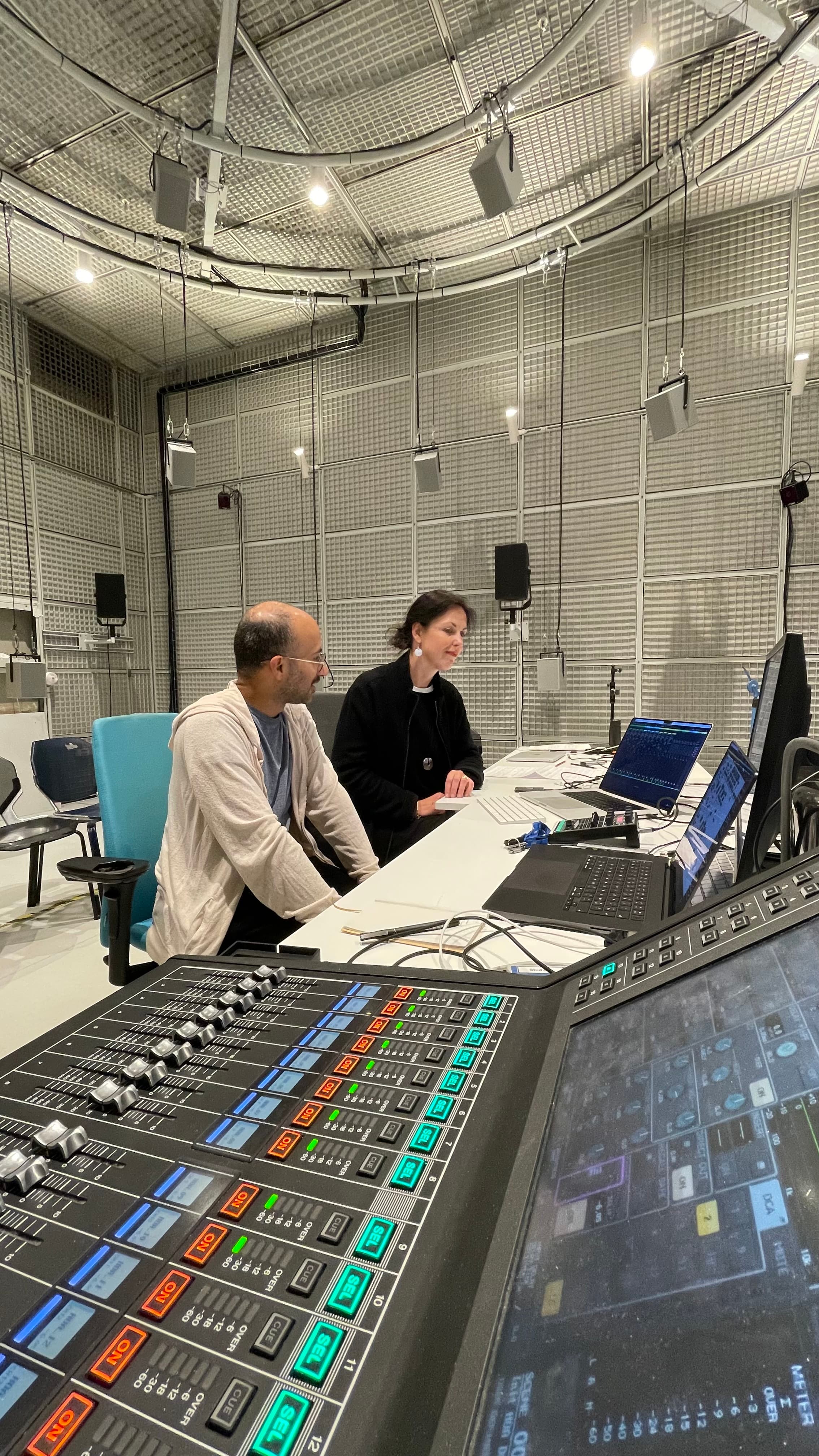 La compositrice Justė Janulytė et Robin Meier, réalisateur informatique musicale associé au projet, en studio à l'Ircam
It all starts with a single note that is played in the highest register of the cello. This note immediately goes through the software SuperVP which analyses it in real-time and singles out, one by one, each partial. These partials are then stretched out and slowed down using Sogs, a granular synthesis model that can produce sounds by putting very short audio samples in a loop. “We also use Iana, which can analyse and extract relevant sound features in real-time – all of that in Max4Live,” specifies computer music designer Robin Meier.
Towards the middle of the twenty-minute long piece and in order to maintain both the sound intensity and the depth of the textures, the cello player trades his usual bow for a mechanical one, which was designed by Léo Maurel, a creator of unusual instruments based in Alsace. As the founder of ARPFIC in 2019 (the Association for the Research and Promotion of Uncommon Instrument Making), Léo Maurel designed a bow that is able to create continuous sounds – that is to say sounds that are uninterrupted by the usual direction shifts of the bow strokes. A band is driven by a small engine: its rotation speed can be controlled by the musician using a pedal. The musician even can, if they wish, rub the four strings of the instrument simultaneously – which is not the case in this piece. They can also change the way the strokes land and weight on the string, just like with a normal bow.
The different voices that make up the canon get separated and move away from each other, almost imperceptibly – creating a texture that gets denser and within which the frequential proximity of the moving partials generates wave interference effects. Towards the end of this odyssey, the fastest line of the canon descends towards the cello’s lowest string, giving shape to the fundamental, while other, slower parts, align with the natural harmonic series. The result gives the impression that a second prism finally recreated the white light spectrum, but this time in the lowest registers.
By Jérémie Szpirglas
Justė Janulytė
Composer
Related to this event
Jun 15, 2026
Ircam, Espace de projection


