

La galerie de l'Ircam
© Ircam-Centre Pompidou, photo : Philippe Barbosa
Alice Cohen-Hadria is a senior lecturer at the Faculty of Science and Engineering at Sorbonne University and a researcher in the Sound Analysis and Synthesis team at the STMS laboratory. With the aim of supporting and recognising women's involvement in research, she decided to join the ranks of the gender equality representatives at Interlab, a group of laboratories that discusses gender equality issues and facilitates the implementation of actions. She shares with us her career path, her commitments and her hopes for the future of scientific research.
What experience of gender parity did you have during your studies in musical computing?
As a lecturer in computer science, it seems to me that the student body is changing; there is more gender diversity today than when I was a student. I remember that, despite being top of my class—which afforded me a certain form of “respect” from my peers—my skills were regularly questioned and I was often subjected to mansplaining, which becomes exhausting over time. When I did the ATIAM Master’s programme at IRCAM, I was in fact the only woman. Even today, this programme is far from being gender-balanced. I nevertheless believe that this Master’s degree can serve as a lever to improve gender parity in research, because at IRCAM, for instance, many of us come from that background. Despite some improvements, there is still a major issue with gender parity in fields perceived as “scientific”, a situation that has not been helped by certain recent reforms, particularly the reform of the baccalauréat, which has led to a step backwards in the proportion of female students in specialised science and mathematics tracks. Our goal is to bring women back into these programmes, and also to ensure the long-term retention of PhD students and postdoctoral researchers, because there is a critical lack of women in permanent positions. It would, however, be a mistake to think that gendered treatment of students is linked to the gender of the lecturer; both women and men can be responsible for this, due to the internalisation of gender stereotypes. That said, as I mentioned earlier, I do feel that things are changing, thanks to shifts in the student population, which go hand in hand with changes in younger generations’ practices. To caricature somewhat: when I was a student, those studying computer science were geeks, enthusiasts, whereas today the field is much more open. Students are motivated by other aspects, such as job security—which is not a bad thing at all!
Could you tell us about the Interlab, where you act as a gender equality officer?
There are more and more initiatives aimed at promoting gender parity, equality and combating discrimination within research institutions. Among them, the CNRS Computer Science Institute—also known as INS2I—which brings together all laboratories at least co-funded by the CNRS and with a computer science component, has been fairly pioneering in this area. It was INS2I that introduced the system of gender equality officers, present in all laboratories (ideally one man and one woman). It was from this initiative that the Interlab was formed in 2023, bringing together five INS2I laboratories, including STMS. Frédéric Bevilacqua was already a gender equality officer for the STMS laboratory, and with the aim of forming a male–female duo, he asked me to join him. As these issues matter to me, I naturally accepted. Pooling ideas and projects within the Interlab is extremely beneficial for smaller laboratories like STMS, as it broadens their resources, scope of action and impact. It is also interesting to discover each laboratory’s internal culture and to work with different people. We meet at more or less regular intervals to discuss the actions we want to carry out and to look for funding.
What motivated you to become a gender equality officer?
Coming from a training background and a laboratory with very few women, gender parity is an issue that resonates strongly with me. Having a female officer seemed essential, both to ensure a fairer distribution of responsibilities and to maintain coherence in our actions. Moreover, together with IRCAM’s “unit for combating sexual harassment and sexist behaviour”, we are one of the first points of contact for people who are victims of sexist and sexual violence—who are predominantly women.
What feedback have you received on the projects already implemented by the Interlab, and what is planned next?
Among the current projects is the “Mentorat Dialogue” scheme. We know that assigning mentors is a powerful lever to facilitate women’s integration and career progression in research. We would nevertheless like to open this scheme to everyone, both men and women. The CNRS is funding us to train mentors not only in active listening, but also in more legal aspects. This pool of mentors will then be assigned, as needed, to PhD students who request support.
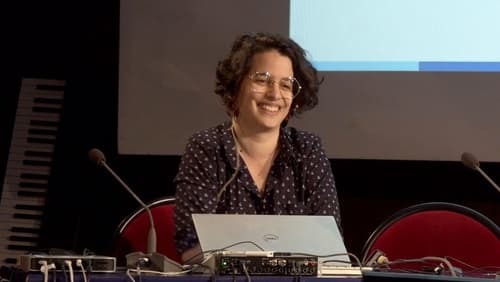 Conférence par Alice Cohen Hadria © Ircam-Centre Pompidou
So far, two half-day training sessions have taken place. Another initiative we would very much like to pursue is making the conference day showcasing the work of women researchers—held last October—an annual event. With its very eclectic programme, the day was a real success. These actions often generate further initiatives; for instance, some women researchers later take part in INS2I gender equality officers’ days. We are also going to organise a meeting in voluntary single-sex format with the women of the STMS laboratory, open to members of the Interlab. For now, this is about launching the project; the first meeting will therefore take the form of an informal breakfast, but the long-term goal is to make these meetings sustainable, as is already the case in other laboratories. The aim is to get to know one another and to discuss topics that matter to us—ranging from the humanities to reporting procedures for sexist and sexual violence, as well as career progression opportunities. Speakers—whether unit directors, permanent researchers or professors—could share their career paths and the difficulties they have encountered. Another initiative we would like to implement is anonymous questionnaires, both qualitative and quantitative, in order to gather feedback from staff about their working conditions within the Interlab laboratories. There is an infinite number of possible actions, and of course we would like to do more, but this requires a great deal of coordination.
That is inspiring. Have you identified initiatives by other research actors aimed at improving gender parity?
I believe that one of the ways to change the current situation is, first and foremost, to send positive signals to women and gender minorities, to show them that measures are being taken and that they belong in research. At university level, it is already difficult to recruit women, but also to retain them. I dislike the term “self-censorship”, because I think it is more a matter of discouragement experienced by women working in highly male-dominated environments, where they are confronted with all kinds of aggression and constant questioning of their skills. The discourse claiming that there are already job offers open to everyone and that the problem simply lies in a lack of applications from women is completely misguided. For example, it is possible to post very broad job offers, so as not to disadvantage women who, according to studies, tend to apply only when they are confident they meet all the required criteria. This is what the IRIF laboratory at Université Paris Cité did for its lecturer recruitments. The result: IRIF has now achieved almost perfect gender parity in its new hires. There are many possible measures, such as using inclusive language in calls for applications and job advertisements. Personally, my Everest would be menstrual leave. This already exists in the French public sector, particularly in local councils, but it still seems difficult to implement in many professional environments in France today, including universities.
“For things to change, women must want to engage in research—and above all, to stay in it.”

Alice Cohen-Hadria
Chercheuse
For things to change, women must want to engage in research—and above all, to stay in it. That requires institutions to build inclusive and safe working environments, ensuring that actions are concrete, reporting mechanisms function properly, governing bodies can be contacted, and effective protective measures are in place. That said, these measures are still quite recent, and the relevant bodies are under heavy demand, which leads to fairly long delays.
Regarding the orientation of young female students towards research, do you see areas for improvement?
I think this involves two main aspects. First, awareness-raising initiatives aimed at young audiences are of course essential. However, we observe a problem when interventions take place in secondary schools: it is often already too late, as students have made their orientation choices. It would therefore be worth reflecting on the most appropriate time to intervene. The second issue is that, because these initiatives operate on a long time scale, we will not see results for several years.
“This also involves better representation, by showcasing profiles of women and gender minorities in academic research”
Alice Cohen-Hadria
Chercheuse
This also involves better representation, by showcasing profiles of women and gender minorities in academic research, particularly in more technical fields such as computer science, which are considered less ‘feminine’. Personally, I am entirely in favour of positive discrimination. I advocate in particular for the creation of research projects and dedicated funding reserved for women, as we observe a severe lack of women in permanent research positions, regardless of the field. I do not know, however, what is legally feasible, as this is far from my area of expertise. It is also essential to train those involved in recruitment, as gender bias can disadvantage female candidates. This is already the case in some selection committees, but not everywhere. This lack of standardisation in recruitment processes is notably due to the multiplicity of recruitment channels. Unfortunately, I believe that legislation is sometimes necessary for the situation to evolve.
We are aware of the various ethical issues raised by AI. As a researcher working on AI, are these questions a concern for you?
That is a very interesting question. The AI methods currently in use require the collection of large volumes of data, largely sourced from the Internet. These data therefore carry not only the biases present online, but also the biases of the people who collect them. Since in both cases we are mostly talking about men (white, cisgender, heterosexual…), AI systems are therefore highly biased. Reflecting on ways to debias these datasets is a research field in its own right, still relatively underexplored and—unsurprisingly—mainly populated by women. It is a fascinating and very topical subject, but unfortunately I do not have the solution to these problems, and I am not very optimistic about the situation. Having more women in computer science and related research fields could already help reduce biases linked to data collection. However, debiasing society itself seems impossible. Beyond gender bias, we also need to consider underprivileged populations, racialised people, people with disabilities, etc., who are very poorly represented. I think we are only scratching the surface when it comes to gender issues, and that there is still a great deal to be done on these other fronts.
Do you have a message or advice for women who would like to pursue a career in scientific research?
Working towards having more women in scientific research is part of my job, but also a somewhat selfish desire as a woman researcher. It is difficult, because I do not want to discourage women, but I also do not want to paint an unrealistically rosy picture. In any case, scientific skills are not gendered; all women are capable and legitimate in this field! If there is one message to convey, I believe it is actually directed more towards young male researchers. It is up to them to ensure that women feel welcome, which involves recognising their own biases, respecting women’s contributions and speaking time, valuing their work, and above all calling out sexist behaviour. Even though everyone has biases—both men and women—it is men who benefit from them the most. It is therefore also up to men to educate themselves and take action, rather than leaving this work—still unpaid—to women alone.

Alice Cohen-Hadria
Chercheuse


