

Pierre Boulez et Brigitte Marger-Mondoloni
© DR
Brigitte Marger-Mondoloni is the eighth person interviewed as part of the RAMHO project. Born in 1936, Brigitte Marger was an English teacher before taking up posts as a chargé de mission at the Directorate-General for Cultural Relations of the Ministry of Foreign Affairs and as cultural attaché to the French Embassy in Great Britain. She met Pierre Boulez in London in 1967 with whom she remained close. In 1973, she became involved in the IRCAM project as head of external relations. In 1982, she was appointed general administrator of the Ensemble intercontemporain. In 1993, she became the first Director General of the Cité de la musique, a position she held until her retirement in 2000.
I visited her home in Paris with Baptiste Bacot on July 25, 2022. The interview lasted just over two and a half hours. We met again in September 2023 to edit and finalise this fascinating account of the creation of IRCAM. We kept in touch afterwards, keeping her informed of the progress of the RAMHO project and more particularly of my research into the history of the IRCAM. It was with deep sadness that I learned of her death on December 3, 2024. With these few unpublished extracts from our interview, I would like to pay my last respects to her and express my sincere condolences to her family and friends.
Brigitte Marger
When I arrived in London [in 1967], it was an exciting time: there was new music, new fashions, emancipation in terms of dress, sex, social life... My years in London were definitely what we called ‘Swinging London’.
François-Xavier Féron
How many years did you stay there?
Brigitte Marger
I stayed for six years and that's when I met Pierre Boulez [...].
François-Xavier Féron
At that time, did you already have a foothold in the sphere of ‘savant’ contemporary music?
Brigitte Marger
I liked avant-garde things, I always have. I really wanted to invite Pierre Boulez because, at the time, he had the image of a rebel. He'd left and slammed the door! He was living in Baden-Baden but had been hired by the BBC at the time.
François-Xavier Féron
When did you first hear about Boulez?
Brigitte Marger
I'd been to concerts at the Domaine musical. I wasn't a musician, but I was a music lover. He was one of the people I really wanted to meet and it was really extraordinarily easy. I got his phone number, called him up and said, "I really admire you. Could we have lunch?" He replied: "Yes, why not."
François-Xavier Féron
Do you remember at what stage of your tenure you met him in London?
Brigitte Marger
Very early on! I think it must have been as early as 1967. We became friends and I used to follow the concerts he gave with the BBC orchestra. There were premieres, notably Éclat / Multiples [premiered in London on October 21, 1970]. We never lost touch from then on [laughs]. Then the moment came when I said to myself that I had to go back to Paris. I think I had one or two offers, but one day Pierre Boulez gave me a very long description of his plans for IRCAM, which fascinated me [...].
François-Xavier Féron
When he gave you this long talk about IRCAM, was he trying to poach you?
Brigitte Marger
No, not at all, but when I asked him, he immediately said yes. He said, "Yes, that's very good because there will certainly be publications." And then I thought ‘oh dear’, because at that time he didn't think there would be many events and concerts.
“At the start, the IRCAM was only supposed to be a research institute [...]”
Brigitte Marger
Director of the Cité de la Musique
At the start, the IRCAM was only supposed to be a research institute [...] He really insisted on that, saying, "You know, Brigitte, there will be publications and there will be relations with the outside world, but we're not here to give concerts."
François-Xavier Féron
That's surprising.
Brigitte Marger
I think you can see that he was a man of... I would say of ‘positive change’ [laughs].
François-Xavier Féron
That's a nice expression!
Brigitte Marger
I don't know if it's tactical or strategic - I've never really understood the difference - but when he saw that a course of action didn't suit his purpose, he changed. That was one of the first reversals that happened. When I offered my services, I thought it was going to be austere and very different from what I was doing in London. When I arrived, I found Paris very boring, but I very quickly realised that the Centre Pompidou was an exciting project, otherwise life in Paris was dead compared with London in the 1970s.
~
Brigitte Marger
Pierre [Boulez] was hardly ever there because he had taken over the direction of the New York orchestra and had kept London. It was hellish! We had no Zoom, no WhatsApp... I remember, for example, picking him up by car at the airport so that I could talk to him between the airport and Paris to prepare the press conference in 1974. And then, fortunately, there was his very good secretary called Astrid Schirmer; she managed to get the papers he sent back to her corrected.
François-Xavier Féron
She followed him everywhere?
Brigitte Marger
Astrid Schirmer became his assistant in London. I think he recruited her when he arrived at the BBC. In London, Pierre had an impresario called [Howard] Hartog whom he liked very much. After his death [in 1990], I don't think he took on any more agents and it was Astrid who took care of all the engagements, contracts and discussions with Bayreuth, New York... She played a very important role! You should know that Pierre Boulez never said no: he was a ‘yes to everything’ man and it was Astrid who had to explain afterwards, "Yes, he did say yes, but perhaps we should postpone it for a year because...".
~
Brigitte Marger
What's quite striking in retrospect is that the IRCAM's initial approach was highly prescriptive, "We'll have to do this, there'll be this; to link up the departments we'll do this." In reality, all this was disrupted and called into question by a number of events, both by the state of the art - in particular by heavy-duty computing, which was very, very disappointing at the time - and by politics. At some point, we had to be able to explain why we were doing all this... And so, in the end, these fine plans, which were the subject of several brochures, were turned completely reworked.
François-Xavier Féron
What brochures are you talking about?
Brigitte Marger
I think the first brochure was distributed at the 1974 press conference and then I produced at least two more. There was a bit of a drama because it was all codified by the very well-known Swiss graphic designer for the Centre Pompidou [Jean Widmer]. The colour attributed to IRCAM was purple. When I showed it to Pierre Boulez, he got very, very angry!
François-Xavier Féron
Because of the colour?
Brigitte Marger
Because of the colour! "Brigitte, that's out of the question, it reminds me of church vestments. It's not possible, I don't want ecclesiastical colours! Tell them it's absolutely out of the question." Finally, we went from purple to violet...
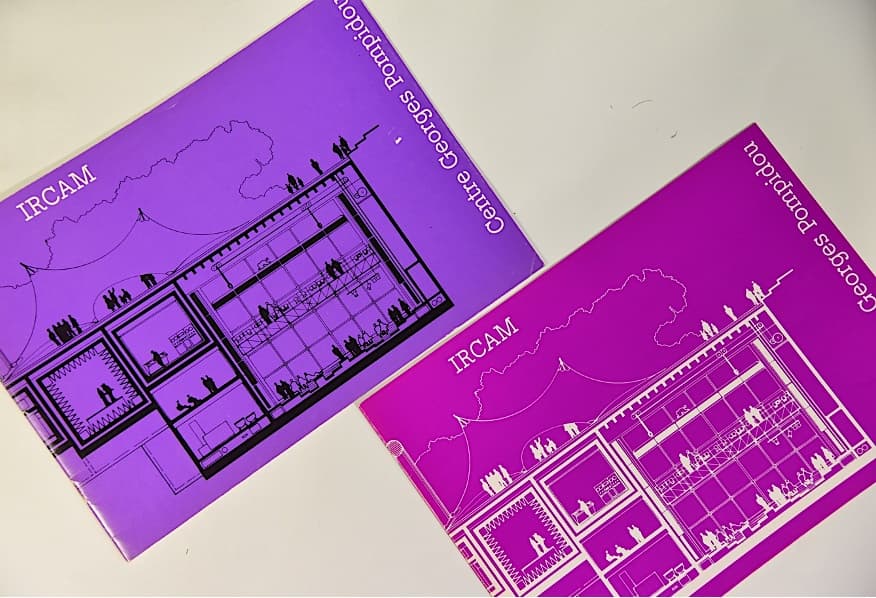 Du violet au pourpre: deux tirages d’une brochure de présentation de l’Ircam parue en 1976 © François-Xavier Féron
~
Brigitte Marger
Pierre had had a commission for the Donaueschingen Festival for a long time. I read in an interview with Andrew [Gerzso] that he really pushed Pierre to get down to work. Composing a new work had become a real challenge. Work accelerated in the summer of 1981. I remember seeing him arrive in the morning and walk across the mezzanine at IRCAM with his big bag.
François-Xavier Féron
So that was shortly before the first version [of Répons on October 18, 1981].
Brigitte Marger
That's it. I remember very well going down to the Espace de projection for the first rehearsal. When I heard the arpeggios, I said to myself, "OK, that's it, we've won!" like the pole vaulter who has cleared the bar [laughs]. In the end, I don't think it was the reorganisation of IRCAM that made this leap forward possible. I think there was this sort of miracle that allowed us to use a technique that wasn't destined to be mature at the time - you know this better than I do, but it was only later that we had the necessary technologies. There was this kind of miracle with the 4A and then the 4X, thanks to the presence of [Giuseppe] Di Giugno and the work with Andrew Gerzso. Répons was several years ahead of the technical advances - well, that's my interpretation. It allowed us to say, "Yes, it's possible. This is what we had to do and we were right to do it!" In a way, IRCAM's mistake was to have been created too early in relation to the state of the art.
By François-Xavier Féron, CNRS researcher in the Analysis of Musical Practices team in the STMS laboratory (IRCAM, Sorbonne University, CNRS, Ministry of Culture)
Quote: Brigitte Marger - Interview with François-Xavier Féron and Baptiste Bacot, July 25, 2022, RAMHO project (Recherche et acoustique musicales en France : une histoire orale), STMS - IRCAM, unpublished.
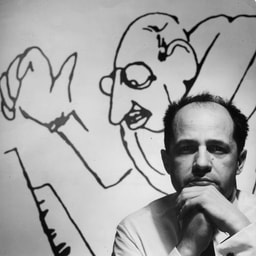
Pierre Boulez
Composer, conductor, founder of IRCAM
Related to this article
The RAMHO Project: Musical Research and Acoustics in France – An Oral History

Michel Decoust was the first person interviewed as part of the RAMHO project. This initial interview, conducted by Vincent Tiffon on February 25, 2019, at the composer's home in Buzet-sur-Tarn, was followed by a second interview conducted by François-Xavier Féron and Vincent Tiffon at IRCAM on November 22, 2021. At the request of Marcel Landowski, Michel Decoust established the Orchestre des Pays de la Loire between 1967 and 1970, before moving on to the Maison de la Culture in Rennes and the Maison de la Culture in Nevers. He later co-founded the Conservatoire de Pantin with Irène Jarsky and Martin Joste in 1972. In 1975, responding to a proposal from Pierre Boulez, he joined the team responsible for the prefiguration of IRCAM as head of the Pedagogy Department, a position he left in 1979 to join the Music Directorate of the Ministry of Culture.

Gerald Bennett is the 32nd person interviewed as part of the RAMHO project. This interview took place on November 22, 2023, at the composer's home in Muttenz in the canton of Basel. Born in New Jersey (United States) in 1942, composer Gerald Bennett studied music at Harvard University. After graduating in 1964, he continued his studies in Switzerland at the Basel Conservatory. He was appointed professor in 1967 and director two years later. Approached by Pierre Boulez in 1971 to take part in the development of IRCAM, he left his post in 1976 to head the institute's Diagonal department until 1980.


fassey-600x331.jpg%3F2026-02-10T11%3A13%3A14.253Z&w=3840&q=90)
