
Andrea%2520Fele%25CC%2581gi%2520%2520Editio%2520Musica%2520Budapest-1920x1280.jpg%3F2026-05-28T14%3A55%3A05.860Z&w=3840&q=90)
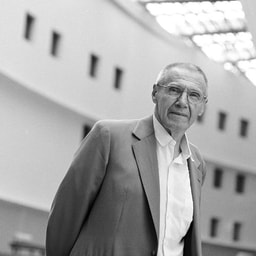
Le compositeur György Kurtág. Photo
© Andrea Felégi / Editio Musica Budapest
Composed between 1976 and 1980, and premiered in Paris on 14 January 1981 by Adrienne Csengery and the Ensemble intercontemporain under the direction of Sylvain Cambreling, "Messages de feu Demoiselle R. V. Troussova" ("Messages of the Late Miss R. V. Troussova") is a cycle of 2 brief movements based on poems in Russian by Rimma Dalos. The work drew the attention of the international musical community to György Kurtág, who was nearly 55 years old at the time, yet still little known outside his native country. It also brought to light a poet of incandescent intensity whose readership remained even more limited.
When the Ensemble intercontemporain was founded in 1976, it did not yet possess a repertoire of its own. Pierre Boulez therefore sought composers who might write for his musicians. After discovering Les Dits de Péter Bornemisza (The Sayings of Péter Bornemisza), a concerto for soprano and piano, he commissioned from Kurtág a work for voice and ensemble: Messages de feu Demoiselle R. V. Troussova for soprano, oboe, clarinet, horn, three percussionists, mandolin, harp, cimbalom, piano, celesta, violin, viola, and double bass. This first work based on texts by a female poet marked the beginning of a long series. Alongside the Messages after Rimma Dalos, Kurtág composed Herdecker Eurythmie (Herdeck Eurythmy) on poems by Ellen Lösch (1979). He would later compose to texts by Amy Károlyi, Anna Akhmatova, Marina Tsvetaeva, and Ulrike Schuster, demonstrating a sensitivity to women's poetry that is among the most distinctive features of his artistic personality.

György Kurtág : Messages de feu Demoiselle R.V. Troussova
0:00 / 3:00
Singing Rimma Dalos
Born in the Soviet Union in 1944, Rimma Troussova adopted the surname of her Hungarian husband, Dalos, and followed him to Budapest in 1970. The title of Kurtág's work, Messages de feu Demoiselle R. V. Troussova, and its subtitle, "21 poems by Rimma Dalos", refer respectively to the poet's maiden name and married name. Commissioned by the Hungaroton label to translate the texts of Les Dits de Péter Bornemisza, Rimma Dalos met the composer at a time when her literary activity was still recent and her poetry little circulated. Her poems share many features with Kurtág's artistic world, particularly brevity and expressive density.
“What misery... What misery love is, yet is there any greater happiness?”
György Kurtág
Excerpts from the sung texts of Messages de feu Demoiselle R. V. Troussova, Op. 17
Rimma Dalos became a central foundation of Kurtág's vocal output. In addition to Messages de feu Demoiselle R. V. Troussova, she inspired four of the six pieces of Omaggio a Luigi Nono for mixed a cappella choir (1979), Scènes d'un roman (Scenes from a Novel) for soprano, violin, double bass, and cimbalom (1979 to 1982), and Requiem pour un ami (Requiem for a Friend) for soprano and piano (1982 to 1987). Three of these scores, namely those for solo soprano, were premiered by Adrienne Csengery, whom András Mihály, composer and director of the Hungarian State Opera at the time, had recommended to Boulez. The singer became one of Kurtág's preferred interpreters. She also gave the first performances of Sept chants (Seven Songs) for soprano and cimbalom (1981), Fragments d'Attila József (Attila József Fragments) for solo soprano (1982), Kafka Fragments for soprano and violin (1987), and Trois inscriptions anciennes (Three Ancient Inscriptions) for soprano and piano (1988).
Kurtág, who had learned Russian in order to read Dostoevsky, penetrated what one commentator called its "transverbal zones, making the Russian word resonate, fortunately without a Hungarian accent", and greatly admired Rimma Dalos. Yet in the Messages, as in the other works, composer and poet worked independently, without consultation. Kurtág did not hesitate to cut passages or alter words. Initially frightened by the prospect of hearing her poems sung, Dalos was astonished by the result: "Kurtág went further than I did. He was more courageous. His music carries my intentions and allusions to their ultimate conclusion."

Kafka-Fragmente (1985-1987)
by György Kurtág, recorded in 1990
0:00 / 3:00
Andrea%2520Fele%25CC%2581gi%2520%2520Editio%2520Musica%2520Budapest.JPG&w=3840&q=75) Le compositeur György Kurtág. Photo © Andrea Felégi / Editio Musica Budapest
Le compositeur György Kurtág. Photo © Andrea Felégi / Editio Musica BudapestIn this cycle of three unequal parts, each longer than the previous one and comprising respectively two, four, and fifteen poems, the music translates certain images through readily identifiable forms of musical illustration. The voice grunts like a pig in Pourquoi ne pousserais je pas (Why Should I Not Squeal?), entirely a cappella. The sounds of breaking glass accompany the needle piercing the heart in La fine aiguille (The Fine Needle). Descending lines evoke rain in Fleurs d'automne qui fanent (Fading Autumn Flowers). The word "fall" is sung through widely separated notes descending from high to low register in En toi (In You).
Yet Kurtág also attends to syntax and phonetic structure, as demonstrated, for example, in Quelle misère (What Misery). The philosopher and musicologist Peter Szendy has observed that the consonants of the Russian word for "love" recur throughout the poem in every other word except the one meaning "happiness". The word "happiness", prolonged through an extended vocalization, thus stands in opposition to the other words, which are treated syllabically. In Pourquoi ne pousserais je pas, the conjunction "when" articulates the two clauses of the sentence. The first, in which the woman speaks in the first-person singular, "Why should I not squeal like a pig?", generates ascending musical gestures. The second, describing the behaviour of "everyone else", "when all around me everyone is grunting", is accompanied by a descent of the voice into an unnaturally low register.
Rimma and Her Double
The very title of Kurtág's score establishes an ambiguous relationship between the author of the texts and the speaker of the poems. Without biographical information, the phrase "the late Miss Troussova" appears fictional and suggests a deceased character. To understand this death symbolically, one must know of Rimma's change of name: the young woman disappears so that the wife may come into being. Or, perhaps she has been consumed by the devastating love whose fragments she offers us. Although the title and subtitle bring together the two names, they do not merge them. Rather, their juxtaposition creates the illusion of a divided identity.
By giving voice to a woman while revealing nothing of her age, social circumstances, or geographical setting, the poems maintain uncertainty regarding her identity and blur the boundary between reality and imagination. To this deliberate ambiguity is added a process of identification on the part of the composer, who declared: "Madame Bovary, Miss Troussova, is me."
“Fading autumn flowers... Fading autumn flowers, endless monotonous rain. Thus, life departs from nature.”
György Kurtág
Excerpts from the sung texts of Messages de feu Demoiselle R. V. Troussova, Op. 17
After the first part of the cycle, entitled Solitude (Solitude), has established the setting of "an empty existence", the following two sections, Quelque peu érotique (Somewhat Erotic) and Expérience amère, Douceur et chagrin (Bitter Experience, Tenderness and Sorrow), explore the inner life of a woman who confides her most intimate feelings. The indirect discourse of the two poems in Solitude gives way to the first-person singular, which dominates most of the remaining texts. As in the opposing poles of Quelle misère, where love is simultaneously a source of happiness and suffering, emotions oscillate between the melancholy delicacy of a dying natural world and a physical desire expressed with startling directness.
Violence, at times approaching hysteria, is accompanied by images of bodily mutilation, "Without you, I am like that woman in the bath with her breasts cut off", and by nightmarish visions. Kurtág himself referred to the first piece of the cycle as Traumeswirren (Dream Confusions), borrowing the title of a movement from Schumann's Fantasiestücke, Op. 12. Despite the ellipses of its fragmented and discontinuous discourse, the ordering of the poems suggests that this destructive yet consciously embraced passion ultimately ends in separation, signalled by the final poem of the cycle, Pour tout (For Everything We Ever Did Together), and reinforced by recurring references to autumn and winter.
“The fine needle... The fine needle of suffering pierces my heart. It will kill me.”
György Kurtág
Excerpts from the sung texts of Messages de feu Demoiselle R. V. Troussova, Op. 17
To convey these heightened emotions, Kurtág requires an exceptionally wide range of vocal techniques. The singing is at times syllabic, at times ornamented with brief melismas, and occasionally unfolds in more extended vocalization. It incorporates Sprechgesang and spoken voice, ranging from whispering to shouting, from panting to animalistic grunting. The vocal line, sometimes measured and sometimes freely declaimed, spans a vast register and abounds in wide intervals.
By taking up material and sonic effects derived from the soprano part, the instruments themselves seem to "speak". Several movements contain lengthy passages without voice, as though the narrative continues beyond words. The diversity of instrumental combinations contributes significantly to the characterization and dramatic force of these miniatures through unusual sonorities rich in resonance: voice and cimbalom in canon in Quelle misère; clarinet, horn, and viola in Jouet (Toy); horn, cimbalom, harp, piano, and gong at the opening of Pourquoi as tu prononcé (Why Did You Utter); and horn, double bass, tam tam, and bass drum in the final piece.
The Life of a Woman
"A dramatic action lies hidden behind Troussova," declared Adrienne Csengery, who regarded the work as a monodrama. For this reason, the Messages have sometimes been compared with Schoenberg's Erwartung (Expectation), although the two works differ profoundly in construction. Schoenberg presents a continuous monologue, whereas Kurtág assembles 21 aphoristic movements, most of the poems in the third section being so brief as to evoke haiku.
This structure, together with the constantly changing instrumental forces, has also prompted comparisons with Schoenberg's Pierrot lunaire. Yet in that work the text is delivered entirely in Sprechgesang.
In reality, Messages de feu Demoiselle R. V. Troussova owes more to the tradition of the song cycle. It is significant that during rehearsals Kurtág frequently asked Adrienne Csengery to sight read or sing Schubert lieder. According to the musicologist Stephen Walsh, Kurtág at one point considered the title Frauenleben und Schicksal (A Woman's Life and Destiny), a probable and perhaps ironic allusion to Schumann's Frauenliebe und Leben (A Woman's Love and Life). Rimma Dalos herself perceived the affinity between the Messages and this intimate tradition:
"Kurtág always chooses what is minimalist and romantic. The poetics of small forms, the aphoristic character, weightlessness, and at the same time immense gravity. To say without saying everything, to touch without breaking, to penetrate without betraying. Every line is a game, a game that never ends. Every line is a sigh. And within that sigh there is life. And there is Romanticism. Not a proud, elevated Romanticism, but the Romanticism of distance and inaccessibility. The Romanticism that comes and goes, that carries one away and never entirely satisfies."
“For everything... For everything we ever did together, I am the one who pays.”
György Kurtág
Excerpts from the sung texts of Messages de feu Demoiselle R. V. Troussova, Op. 17
Conceived as a form of discourse, Kurtág's music creates connections between individuals, weaving here a network of multiple relationships. It links Troussova and Dalos, the speaker and her lover, Kurtág, the poet, and the poetic personae, the performers and the composer. It also connects us, the listeners, to these fictional and real beings.
The word "message", which opens the title, recurs elsewhere in Kurtág's oeuvre as either a title or subtitle. Yet the existence of the message often remains hidden and its meaning elusive. Without access to the score or libretto of Troussova, one would not know that each of the three sections is preceded by an epigraph. Neither sung nor read aloud, these epigraphs are drawn from Anna Akhmatova in Solitude and Quelque peu érotique, Goethe in Quelque peu érotique, and Alexander Blok in Expérience amère, Douceur et chagrin.
Several lines by Blok also serve as an epilogue. The score identifies him as "a poet passionately loved by the deceased". Might he be the intended recipient of Miss Troussova's messages? This intertextuality also recalls the approach of Luigi Nono, who punctuated his string quartet Fragmente, Stille, an Diotima (Fragments, Silence, to Diotima) (1979 to 1980) with literary quotations. The two composers seem almost to exchange concealed messages, for Kurtág postponed the completion of Messages de feu Demoiselle R. V. Troussova in order to set Rimma Dalos's poems in Omaggio a Luigi Nono.
By Hélène Cao
György Kurtág
Related to this event
Jun 5, 2026
Cité de la musique - Philharmonie de Paris, Salle des concerts


